SWMM - Time Pattern
Time patterns allow the external dry weather flow (DWF) to vary periodically. They consist of a set of adjustment factors applied as multipliers to a baseline DWF rate or pollutant concentration. The different types of time patterns include:
- Monthly - A monthly multiplier for each month of the year
- Weekly - A daily multiplier for each day of the week
- Hourly - A multiplier for each hour, from 12 AM to 11 PM
- Weekend - Weekend hourly multipliers for weekend days
Each dry weather inflow (flow or quality) can have up to four patterns associated with it, one for each type listed above.
Monthly time patterns can also be used to adjust the baseline values ??of the following hydrological parameters:
Time patterns have the following properties:
- Identification
- Description (Description, String) - Use a user-friendly description when the item name is not sufficient
- Name (Name, String) - Item name
Avoid very long names or names containing the following characters: '*', '>', '<', '/', '\', '"', ':', ';', '|', '=', '`', '#', ',', '?'
- Object
- Priority (Priority, Enum) - Information about the item's current status. Can be:
 Neutral: no issues
 Critical: An issue preventing the calculation or use of the item
- Error Assessment (CurveError, Enum) Result of the data assessment
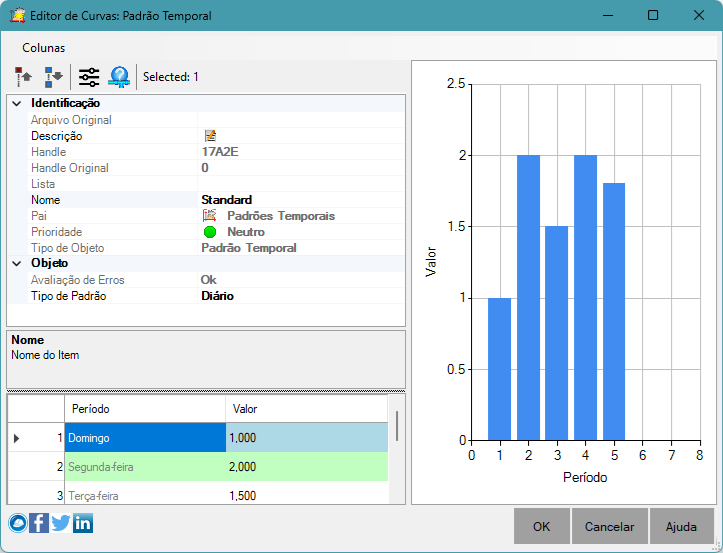
- Curve Data (CurveData, IListClonavel) - the curve data, with the columns:
- Item (Item, Enum) - item identification
- Value (Value, Double) - the value to be used
- Pattern Type (PatternType, Enum) - Type of time pattern
- Error Assessment (CurveError, Enum) - Result of the data assessment
The data is populated in the table and plotted on the graph for better visualization: